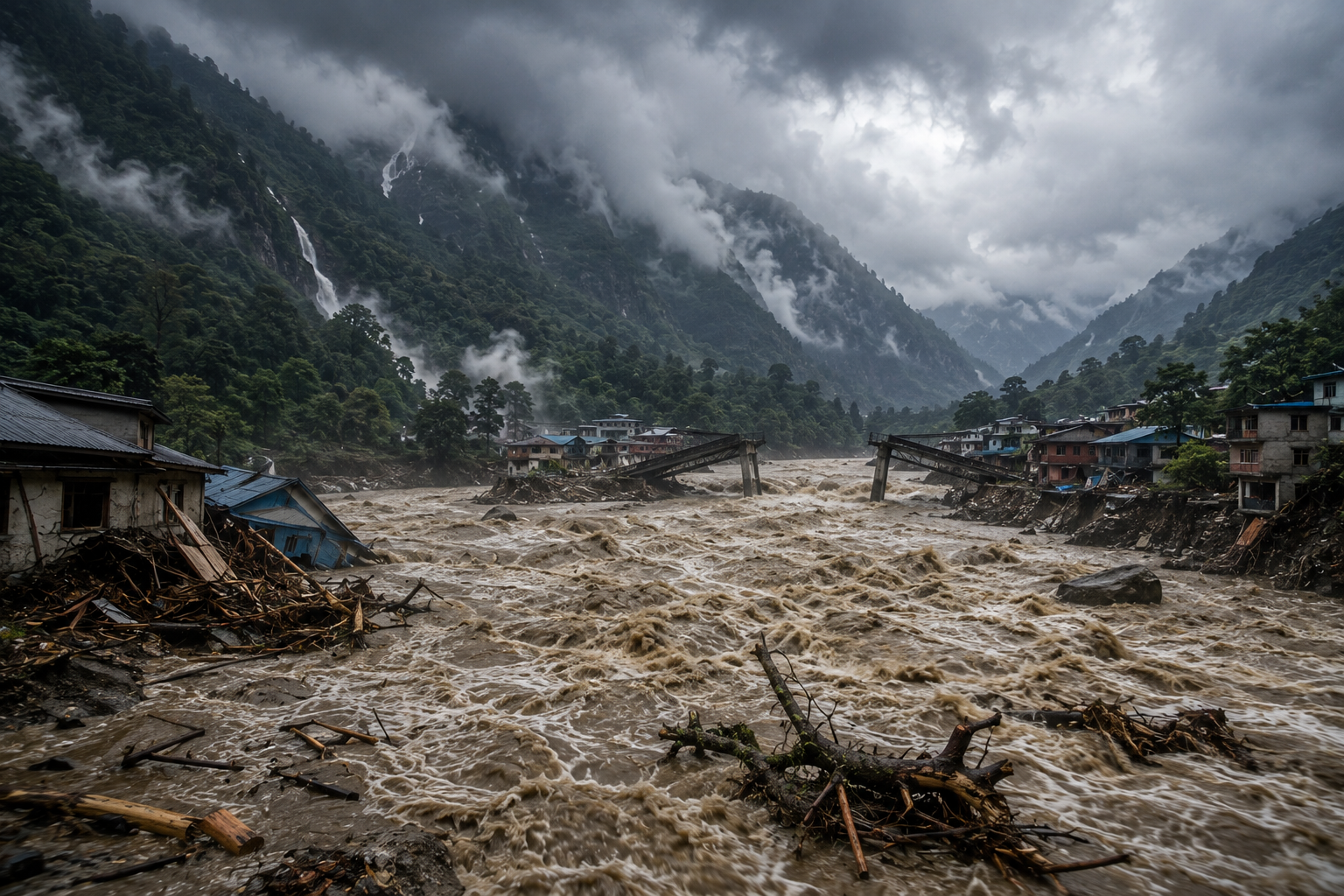
When the Himalayas turned into violent inside Nepal’s deadly floods .Nepal is globally known for its spectacular Himalayan landscape, glaciers, rivers and biodiversity. However, the same geography that makes Nepal unique also makes the country highly vulnerable to natural hazards such as landslides, avalanches, earthquakes and floods.Inside Nepal Floods 2026
The devastating Nepal Flood 2026 has once again highlighted the vulnerability of Himalayan communities to rapidly developing natural disasters. The event was not simply a conventional monsoon flood. It involved a complex combination of high-altitude slope instability, ice and rock movement, debris flow and sudden flooding of river systems.
The disaster affected communities, roads, bridges, schools and hydropower infrastructure in several areas of Nepal. Rescue and relief operations have involved Nepalese authorities as well as international assistance.
More importantly, the event has raised a major scientific question:
How are changing Himalayan environmental conditions influencing the risk of extreme floods and other disasters?
This case study explores the causes, scientific background, human impact, climate connection and lessons emerging from the Nepal flood.
1. What Happened in Nepal?
Inside Nepal Floods 2026
The 2026 disaster developed in the Himalayan region near the Nepal–Tibet border.
A major part of the event involved the rapid movement of ice, rocks and other mountain debris from high-altitude areas into river systems. When large quantities of water and debris suddenly enter a river channel, the flow can become extremely powerful.
The resulting flood wave can travel downstream rapidly, leaving communities with very little time to respond.
The affected river systems included areas associated with the Bhote Koshi and Trishuli rivers, where settlements and infrastructure are located along narrow Himalayan valleys.
Unlike a slowly developing flood, a flash flood can transform a relatively normal river into a dangerous torrent within a short period of time.
This rapid development is one of the biggest reasons why flash floods are so difficult to manage.
2. How Did the Flood Become So Destructive?
Inside Nepal Floods 2026
To understand the Nepal disaster, it is important to understand the interaction between glaciers, mountains, rivers and climate.
High-altitude Himalayan landscapes contain glaciers, snowfields, steep rock slopes and frozen ground. These systems are naturally dynamic, but changes in temperature and precipitation can influence their stability.
When ice and rock masses suddenly collapse or move downslope, they can enter a river valley.
This can produce several effects:
Ice + Rock + Water + Sediment → Rapid Debris Flow → Powerful Flood Wave
The debris can increase the destructive power of the water by carrying rocks, mud and other material downstream.
In narrow Himalayan valleys, the physical landscape can further concentrate the flow, increasing its speed and destructive potential.
Therefore, the disaster should be understood as a multi-hazard event, rather than simply a case of heavy rainfall.
3. Flash Flood vs. Normal Flood
Inside Nepal Floods 2026
One of the most important concepts in this case study is the difference between a normal flood and a flash flood.
Normal Flood
A conventional river flood may develop gradually after prolonged rainfall or snowmelt. Water levels can rise over hours or days, giving communities more time to prepare.
Flash Flood
A flash flood develops much more rapidly.
It can occur following:
- Extremely intense rainfall
- Sudden glacier or ice-related events
- Landslides
- Dam or natural lake failures
- Rapid debris movement
The Nepal event demonstrates why Himalayan communities require monitoring systems that can detect not only rainfall but also glacier movement, landslides, river levels and upstream hazards.
4. The Human Impact
The most important part of any disaster is its effect on people.
The Nepal flood caused deaths, injuries, displacement and major disruption to communities. Infrastructure was also severely affected, including roads, bridges, schools and hydropower facilities.
Many Himalayan communities depend directly on local infrastructure for transportation, education, employment and access to essential services.
When bridges and roads are damaged, isolated communities can face difficulties accessing:
- Food
- Drinking water
- Healthcare
- Education
- Emergency services
- Communication networks
Children are particularly vulnerable during disasters because displacement can interrupt schooling and increase risks related to health, nutrition and safety.
The disaster therefore represents not only an environmental crisis but also a humanitarian and social crisis.
5. A Powerful Example of Early Warning
One of the most important lessons from the Nepal disaster is the value of early evacuation.
In one reported case, the principal of a school in the affected region recognized the danger and moved hundreds of students to safer ground before floodwaters caused severe damage to the school.
The incident demonstrates a crucial principle of disaster management:
A natural hazard does not automatically have to become a human catastrophe.
Early warnings, trained local communities and rapid decision-making can significantly reduce loss of life.
Technology is important, but local awareness is equally important.
A sophisticated warning system is useful only when people receive the warning, understand it and know what action to take.
6. What Is the Role of Climate Change?
Climate change is one of the most important scientific dimensions of the Nepal flood case.
However, it is important to avoid oversimplifying the issue.
It would not be scientifically correct to say that climate change alone “caused” this particular flood.
Natural geological processes, rainfall, topography and mountain instability can all contribute to such events.
However, climate change can alter the Himalayan environment in ways that may influence the frequency or severity of certain hazards.
Possible climate-related changes include:
- Rising temperatures
- Glacier retreat
- Changes in snow accumulation
- Changes in precipitation patterns
- Increased instability of some high-altitude slopes
- Changes in glacial lakes and meltwater systems
As glaciers and mountain environments change, scientists are increasingly concerned about the risks associated with glacial lake outburst floods, landslides, avalanches and other cascading hazards.
This means climate change should not be viewed only as a problem of rising temperatures.
It can also become a problem of water security, infrastructure safety, biodiversity and human survival.
7. Why Are Himalayan Regions So Vulnerable?
The Himalayas are among the world’s most dynamic mountain systems.
Several factors increase disaster vulnerability in the region.
1. Steep Slopes
Steep terrain allows water, rocks, snow and debris to move rapidly downhill.
2. Narrow River Valleys
Many settlements and infrastructure projects are located close to rivers because valleys provide relatively accessible routes through mountainous terrain.
3. Rapid Environmental Change
Temperature and precipitation changes can affect snow, ice, glaciers and slopes.
4. Growing Infrastructure
Road construction, hydropower development and settlement expansion are increasing human activity in mountain environments.
5. Limited Evacuation Time
In a flash flood, communities may have only a short period to respond.
Together, these factors create a complex disaster-risk environment.
8. The Hydropower Challenge
Hydropower is extremely important for Nepal’s economy and energy development.
However, many hydropower projects are located in mountainous regions close to rivers.
This creates a difficult balance.
On one hand, hydropower provides:
- Electricity
- Employment
- Economic development
- Infrastructure
On the other hand, hydropower facilities can be exposed to:
- Floods
- Landslides
- Debris flows
- Rockfalls
- Earthquakes
The Nepal flood therefore raises an important question for future development:
How can countries continue building essential infrastructure while ensuring that infrastructure remains resilient to changing environmental risks?
Future hydropower and road projects will need increasingly sophisticated hazard assessments and climate-resilient engineering.
9. Biodiversity and Ecosystem Impact
Flood disasters do not affect humans alone.
Himalayan ecosystems contain unique plants, animals and microorganisms adapted to extreme environmental conditions.
Sudden floods and debris flows can:
- Destroy vegetation
- Alter river channels
- Increase sediment loads
- Damage aquatic habitats
- Disrupt wildlife movement
- Change local ecosystems
Rivers are particularly important ecological systems.
They provide habitats for aquatic organisms and connect different parts of mountain ecosystems.
A major change in river structure can therefore have effects that continue long after the floodwaters disappear.
This makes disaster recovery an ecological challenge as well as an engineering challenge.
10. What Can India Learn From Nepal?
The Nepal case is also relevant to India because the Himalayan system extends across several countries, including India.
Indian Himalayan states such as Uttarakhand, Himachal Pradesh, Sikkim, Arunachal Pradesh and parts of Jammu & Kashmir and Ladakh face different combinations of flood, landslide, avalanche and glacier-related risks.
The lesson is not that every Himalayan region will experience exactly the same disaster.
Instead, the broader lesson is that mountain ecosystems require continuous monitoring and careful development planning.
India and other Himalayan countries can benefit from:
- Better satellite monitoring
- Glacier research
- River-level sensors
- Improved weather forecasting
- Community-based disaster preparedness
- Climate-resilient infrastructure
- Cross-border scientific cooperation
The Nepal disaster therefore has significance far beyond Nepal itself. The Nepal Flood 2026 is much more than a story of rising water.It is a powerful case study of how geology, climate, glaciers, rivers, ecosystems, infrastructure and human communities can interact to create a complex natural disaster.The event highlights the growing importance of understanding Himalayan environmental change. It also demonstrates that disaster preparedness can be just as important as disaster response.
We cannot prevent every landslide, glacier collapse or flash flood.But we can improve our ability to predict hazards, warn communities, design stronger infrastructure and respond quickly.
The future of Himalayan safety will depend on a combination of science, technology, responsible development, environmental protection and community preparedness.
The most important question is therefore not simply:
“When will the next flood happen?”
The more important question is:
“Will we be prepared when it happens?”
The answer will determine how many future natural hazards remain disasters—and how many become events that communities can survive and recover from.